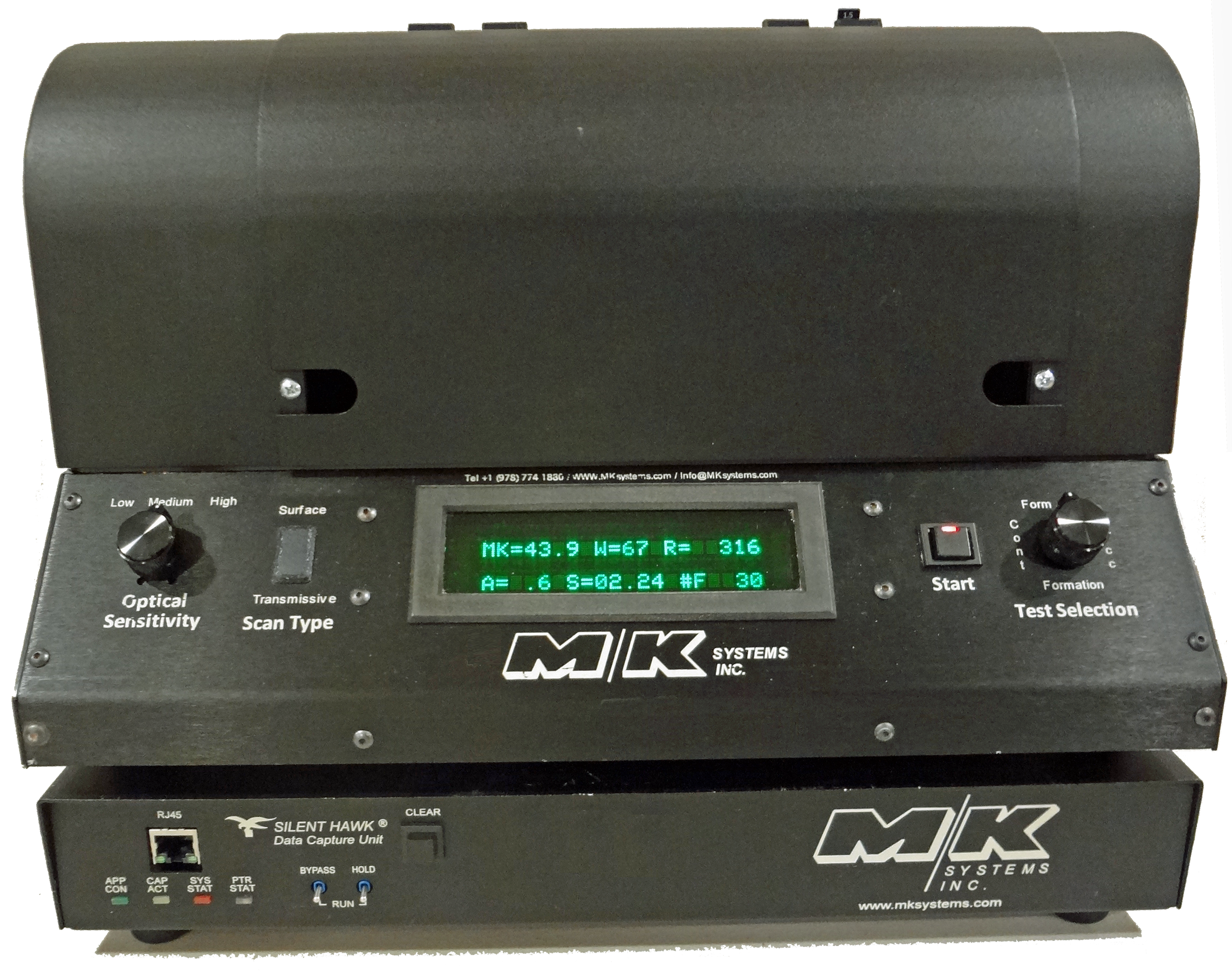
The M/K 3D Formation Tester model 1200: The most accurate Formation Tester available. Measure Formation Index, Flocs, Basis Weight, and Surface Roughness. More accurate than ALL camera systems. Now scan LINERBAORD materials. Compare!

The Precision Optical Scanning Design

This M/K Formation Tester scans your sheet over an 8" x 12" area, measuring each pixel independently.   This precise scan records thousands of different optical densities in your sheet, and generates the well-known M/K Formation Index.   This Formation Index ranks your paper's formation to easily rank your sheet on a scale from 1 to over 100.    The measurements include the M/K Index, floc data, low density data, and optical basis weight.  This device is so sensitive that it actually measures basis weight optically.   Our device is well accepted by the industry and has many patent references and publications.

Try the "flip paper test" on any Camera based system

Only the M/K Formation Analyzer scans a large area of 8"x11" in a single scan, something no other optical device can match.   Our device is so accurate, it actually correlates with basis weights.   Each paper is scanned for its density at the start of each test.  Best of all, the M/K 3D formation analyzer is not limited by camera system problems of focal length problems, lens curvature issues, or light-bouncing.  Test each side of the sheet by flipping over your paper to confirm the results are correct -- this is the only pure optical transmission system available. By analyzing each pixel independently, the M/K avoids the "cloudy light" effects endemic in all camera systems.   Our focused light beam channels through a finite aperture to scan each pixel independently.  This accuracy is not attainable in other light-based systems.

Correlating M/K Data with other physical properties

Correlations with the M/K Formation Index
The MK formation index typically correlates well with other physical test such as tensile tests.   The higher the MK formation index, the stronger (generally) is your paper.

The M/K Optical Basis Weight measurement correlates strongly with actual basis weight within a given grade of paper.   This allows you to measure your sheet density optically.  Such precision is not available in camera systems. 

Additionally, the MK reflection roughness measurements correlate well with print mottle. 

The device now offers an enhanced and extremely thorough scan, with greater discrimination than earlier versions. It can analyze via transmission samples from 5 grams/m2 to sheets greater than 600 grams/m2.   The instrument now also offers an enhanced light and optical source, which allows operators to easily scan linerboard materials and other dense grades of paper.